
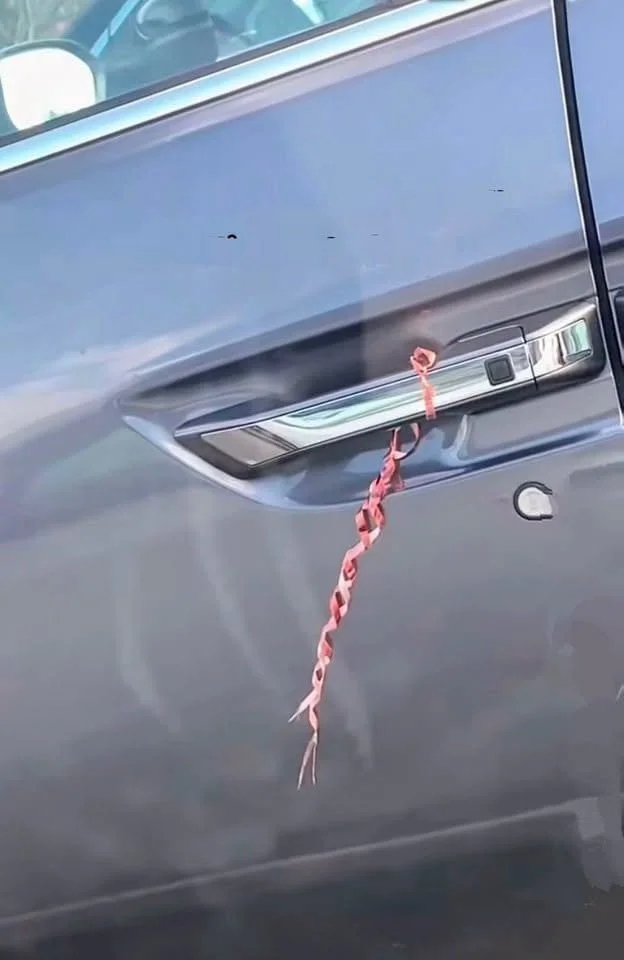
If you notice someone nearby, do not automatically assume that the person is responsible for the object.
Confronting someone based only on suspicion can create an unnecessary conflict.
If a person threatens you, follows you persistently, attempts to block your movement, or tries to force you into another location, prioritize getting to safety and contacting local emergency services.
Step 4: Ask for assistance if you feel unsafe
If you are in a shopping center, workplace, hotel, or other managed parking area, you may be able to ask security personnel for assistance.
If you suspect a crime, have observed threatening behavior, or discover signs of vehicle tampering, report the specific facts to the appropriate authorities.
Explain what you observed without presenting an unverified explanation as a confirmed fact.
For example, saying, “Someone appears to have attached an object to my door handle, and I noticed a person trying to open my vehicle,” provides more useful information than simply repeating a rumor about human trafficking.
Step 5: Leave if there is a genuine immediate threat
If someone is threatening you or attempting to approach you aggressively, do not stay to investigate the object.
Move toward a safe, populated location if you can do so without increasing the danger.
Call local emergency services when necessary.
Your safety should always take priority over identifying the origin of a piece of string.
5. Should You Remove the String or Get Into Your Car?
There is no single rule that applies to every situation.
If you find an ordinary piece of string attached to your vehicle in a busy, well-lit parking lot, with no other suspicious activity, you can assess the situation calmly.
If the object appears harmless and you feel safe, you may choose to remove it or ask parking staff for assistance.
If you notice signs of tampering, a threatening individual, or an immediate safety concern, do not remain in the area merely to investigate.
The right decision depends on the circumstances.
It is also important to remember that the presence of string does not establish that the car is being monitored or that someone is waiting nearby.
Avoid allowing a viral warning to convince you that an attack is inevitable.
Instead, look at the actual evidence available to you and take reasonable precautions.
6. Practical Ways to Stay Safe in Parking Lots
You do not need to live in fear to protect yourself. A few everyday habits can help you feel more confident when approaching your vehicle.
Park in visible, well-lit areas
When possible, choose parking spaces with good lighting and regular pedestrian activity.
Discover more
Herb
HERB
Drink
A location near a staffed entrance or security desk may offer additional reassurance, particularly when parking after dark.
Lighting and visibility can help you notice your surroundings and make it easier for others to see what is happening.
Keep your keys accessible before approaching the car
Avoid standing beside your vehicle for an extended period while searching through a bag for your keys.
Having your keys ready can make entering the car more convenient.
However, keep them secure so that they are not easily lost or taken.
Check your surroundings without becoming fearful
It is reasonable to notice what is happening around you.
If someone appears to be following you or repeatedly approaching you despite your efforts to move away, consider entering a staffed location and asking for help.
At the same time, do not interpret every person standing nearby as a potential criminal.
Awareness is about noticing meaningful behavior, not assuming that everyone is dangerous.
Lock the doors after entering
Once you are inside your vehicle, lock the doors and ensure the vehicle is secured before driving away.
Avoid leaving the engine running unattended.
Do not leave valuables visible in the car, and make sure your windows are closed when appropriate.
These habits can reduce opportunities for theft and other unwanted access.
Trust specific warning signs, not rumors
If someone attempts to grab you, blocks your path, threatens you, or tries to force you into a vehicle, treat the situation seriously.
These are direct behaviors that justify taking protective action.
Discover more
Browse Reference
Learn a Language
Shop Kitchenware
A piece of string alone is not equivalent to evidence of an attempted abduction.
Learning to distinguish actual behavior from speculation can help people respond more effectively to real dangers.
7. What Are More Established Ways Criminals May Target Vehicles?
Although the string-on-the-handle rumor is not supported as a widespread trafficking tactic, vehicle theft and attacks against drivers are genuine concerns in some circumstances.
Understanding better-established risks can help drivers focus their attention on practical prevention.
Vehicle theft
Criminals may attempt to steal vehicles by exploiting weak security practices, stealing keys, or targeting weaknesses in electronic security systems.
Drivers can reduce some risks by locking their vehicles, securing their keys, parking in safer locations, and using appropriate anti-theft devices.
Owners of keyless vehicles should follow manufacturer guidance on protecting their electronic keys.
Theft from parked cars
Visible bags, phones, wallets, and other valuables can attract opportunistic thieves.
Whenever possible, remove valuables from the vehicle or store them securely out of sight before arriving at your destination.
Do not leave important documents containing personal information where they are easily accessible.
Robbery or threatening behavior
In some situations, a person may attempt to rob or threaten a driver directly.
If someone behaves aggressively, attempts to force entry, or threatens physical harm, prioritize your safety over protecting property.
Avoid escalating a confrontation when a safe alternative is available.
Electronic vehicle security attacks
Some modern vehicles with keyless entry can be vulnerable to certain electronic attacks, depending on their technology and security features.
Vehicle owners can consult the manufacturer’s recommendations and consider suitable signal-blocking devices where appropriate.
These are examples of risks for which practical preventive measures exist. They are more useful to understand than an unverified claim that a piece of string automatically identifies a person as a trafficking target.
8. Understanding Human Trafficking Without Falling for Myths
Human trafficking is a serious crime involving exploitation through force, fraud, coercion, or other means defined by applicable law.
It can involve sexual exploitation, forced labor, domestic servitude, and other forms of abuse.
However, popular stories sometimes portray trafficking as a crime in which strangers routinely abduct random people from parking lots using elaborate tricks.
That portrayal can be misleading.
Trafficking situations vary, and exploitation may involve people who know one another, deceptive offers of employment, manipulation, threats, abuse of vulnerability, or control over a person’s circumstances.
Not every trafficking case follows the same pattern, and it would be inaccurate to suggest that strangers are never involved.
Nevertheless, claims about a particular tactic should be supported by evidence before being shared as fact.
A piece of string on a vehicle does not establish that trafficking is occurring.
More meaningful concerns may include a person being threatened, controlled, exploited, prevented from leaving, or pressured into activities through coercion or deception.
Discover more
Find Recipes
Book Cleaning
Get Toiletries
If you suspect that someone is being exploited, report the specific behavior to the appropriate authorities or a qualified support organization.
Avoid approaching suspected offenders or attempting to conduct your own investigation if doing so could put you or another person at risk.
Responsible awareness means taking credible concerns seriously without turning unverified rumors into accepted facts.
9. How to Check Whether a Viral Safety Warning Is True
Before forwarding a frightening warning to family members or friends, take a moment to evaluate the information.
This is particularly important when a post asks readers to share it urgently or claims that police have confirmed a dangerous new tactic.
Start by asking a few simple questions.
Does the post identify a verifiable incident?
Look for a date, location, police statement, or credible news report. A photograph with a dramatic caption is not enough to establish what happened.
Are the sources independent?
If several pages repeat the same wording and image, they may all be copying one original post rather than reporting separate incidents.
Have local authorities confirmed the claim?
When a post alleges a specific criminal method, check whether the relevant police department or another reliable authority has addressed it.
A lack of confirmation does not prove that no individual incident has ever occurred, but it means the claim should not be presented as established fact.
Does the explanation rely on fear rather than evidence?
Be cautious when a post claims that every person who encounters a particular object is in danger or that a secret criminal group is operating everywhere.
Extreme certainty is not a substitute for proof.
Would sharing the post help people make a better decision?
A responsible warning should explain what is known, what remains uncertain, and which practical steps are appropriate.
If the information cannot be verified, it is better to share general safety advice than to spread an unsupported claim.
10. What If You Have Already Found Something Attached to Your Car?

