
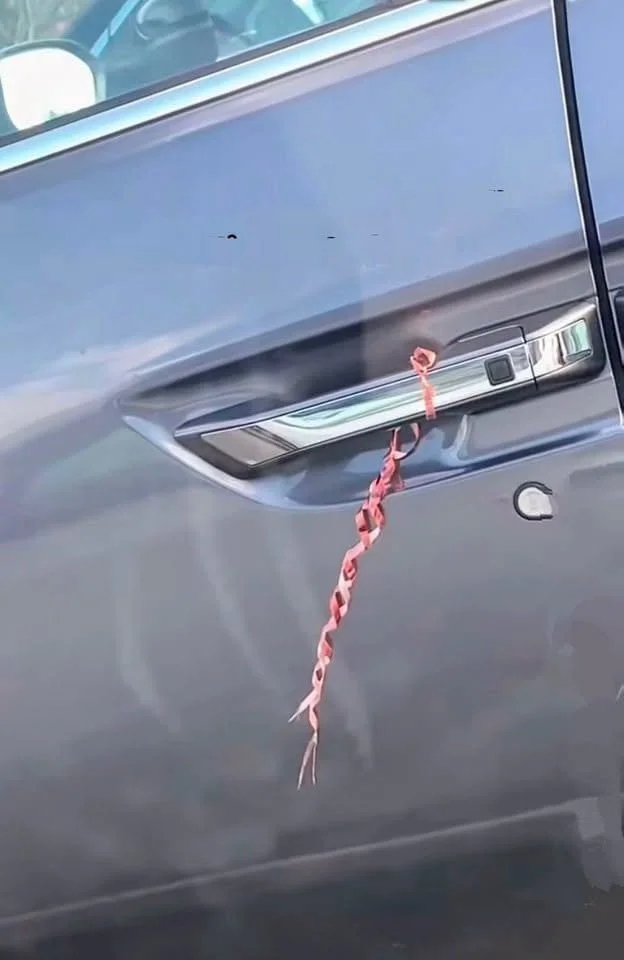
Imagine walking toward your parked car and noticing a strange piece of string twisted around the door handle. You do not remember seeing it before, and you have no idea how it got there. Would you be worried? Would you remove it immediately, or would you wonder whether someone had deliberately placed it there?Shop Car Wax
Images of strings, wires, ribbons, and plastic ties attached to car door handles frequently circulate on social media, often accompanied by alarming warnings about criminals targeting unsuspecting drivers. Some posts claim that these objects are used to distract people, identify potential victims, or create an opportunity for an attack.
Although it is sensible to pay attention to your surroundings, finding a piece of string on a car door handle does not, by itself, prove that someone is planning to abduct you or steal your vehicle. Similar warnings have circulated for years, and law enforcement agencies and fact-checkers have found no reliable evidence that the widely shared string or zip-tie tactic is a common method used by human traffickers.
That does not mean you should ignore every suspicious situation. Instead, it is important to understand the difference between a genuinely concerning incident and an alarming social media story that has not been verified.
Here is what a piece of string on a car door handle might mean, how to respond safely, and which practical precautions can help protect you when approaching your vehicle.
1. Why Would Someone Tie String to a Car Door Handle?
There is no single explanation for why a piece of string might appear on a vehicle. Without additional information, it is impossible to determine who placed it there or why.
Discover more
Buy Lumber
Vehicles
door
Several ordinary explanations are possible.
It may be an innocent accident
String, ribbon, and other lightweight materials can become caught on objects in public places.
A piece of material may have come from packaging, decorations, a shopping bag, or something carried by a pedestrian. Wind can move loose materials around a parking area, allowing them to become tangled in door handles, mirrors, or other parts of a vehicle.
Sometimes, an object that looks deliberately attached may simply have become caught there accidentally.
It could be a prank
Some people deliberately attach harmless objects to vehicles as a joke or prank.
Although this behavior can be irritating and may cause concern, it does not automatically mean the vehicle’s owner has been selected as a target for a serious crime.
If the object appears to have been deliberately placed there, avoid making assumptions about the person’s intentions without further evidence.
It may be connected to vandalism
In some circumstances, an object attached to a vehicle could be part of an attempt to annoy, intimidate, or damage property.Compare Windows
For example, someone might leave an object on a car as a prank or in connection with a personal dispute.
If the vehicle has also been scratched, damaged, tampered with, or repeatedly targeted, the overall situation may warrant a report to the appropriate authorities.
It could be part of a social media stunt
Unusual objects attached to cars can also attract attention online.
A person may deliberately create a strange-looking scene, photograph it, and share the image to generate reactions. Others may copy the behavior after seeing a viral post.
Once an image begins circulating, viewers may interpret the object according to an existing rumor, even when its actual origin is unknown.
Discover more
door handles
Door Handle
Get Fishing Gear
The key point is that the object alone does not reveal the motive behind it.
2. Is String on a Car Door Handle a Sign of Human Trafficking?
This is one of the most common claims associated with viral images of strings and plastic ties attached to vehicles.
Some social media posts suggest that criminals attach these objects to car handles to distract drivers while they attempt to remove them. According to the claims, the extra time spent removing the object gives an attacker an opportunity to approach the victim.
Other versions claim that the objects are used to mark vehicles belonging to people who have been selected for kidnapping or human trafficking.
These stories can be frightening, particularly for people who regularly park alone or travel at night.
However, there is no reliable evidence that the string-on-a-door-handle tactic described in these viral warnings is a widespread or established method of human trafficking.
Fact-checking organizations have investigated similar claims involving plastic zip ties attached to car door handles. They reported that authorities had not found evidence supporting the dramatic explanations circulating online.
The same rumors have appeared repeatedly in different cities and countries, often with slightly different details.
One version involves a plastic tie. Another involves a wire. Others mention a piece of ribbon, a banknote, or an object placed beneath a windshield wiper.
The story changes, but the underlying claim is often the same: an unfamiliar object is presented as proof that a dangerous criminal group is targeting unsuspecting strangers.
It is important not to confuse an unverified warning with evidence of an actual crime.Learn Road Rules
Human trafficking is a serious problem that deserves attention and effective prevention. However, spreading unsupported claims about specific tactics can create unnecessary fear and distract people from better-established warning signs of exploitation.
A sensible response combines awareness with verification rather than assuming that every unusual object signals a kidnapping attempt.
3. Why Do These Warnings Spread So Quickly Online?
A photograph of an unfamiliar object attached to a car can create an immediate emotional reaction.
People naturally want to understand unexpected situations, especially when personal safety may be involved. When a post suggests that a simple object could be connected to kidnapping or trafficking, readers may share it before checking whether the claim is true.
Several factors help these warnings spread.
Fear attracts attention
Posts that describe an ordinary situation as a potential life-threatening danger are likely to attract strong reactions.
A headline suggesting that a person could be kidnapped because of a piece of string is more emotionally intense than a neutral explanation that the object’s origin is unknown.
Emotional reactions can encourage people to share the post with friends and relatives.
Personal stories can appear convincing
Some posts include statements such as, “This happened to my friend,” or “A police officer warned us about this.”
However, a personal account does not automatically establish that the event occurred as described.
Important details may be missing, misunderstood, or repeated inaccurately as a story spreads from one person to another.
A reliable report should include enough verifiable information to establish what happened and whether authorities confirmed the suspected criminal activity.
Repeated claims can seem like proof
When people see the same warning on multiple social media pages, they may assume that numerous independent incidents have occurred.
But many posts may simply repeat the same original rumor.
A hundred copies of one unverified story do not equal a hundred confirmed incidents.
Images do not reveal intent
A photograph may clearly show a piece of string tied to a car handle, but it cannot establish who placed it there, when it happened, or why.Compare Cars
The image can document the object’s appearance without proving the explanation attached to it.
This distinction is particularly important when a post uses a dramatic caption to encourage fear.
4. What Should You Do If You Find String on Your Car?
Although the viral explanation is not supported by reliable evidence as a widespread criminal tactic, you should still use ordinary safety precautions if you find something unusual on your vehicle.
You do not need to panic, but you also do not need to ignore your surroundings.
Step 1: Pause and look around
Before approaching the vehicle, take a moment to observe the immediate area.
Look for obvious hazards, nearby activity, and anything else that appears unusual.
You do not need to search the entire parking lot or investigate strangers. Simply remain aware of your surroundings, as you would when approaching your car at any time.
If the area feels unsafe or someone is behaving threateningly, move toward a staffed building or another populated location.
Step 2: Avoid rushing to remove the object
If the string is harmless-looking and there is no immediate danger, there is generally no reason to assume that removing it will trigger an attack.
However, you do not have to touch an unfamiliar object if you are uncomfortable doing so.
If it appears suspicious, is attached to something that could be dangerous, or is accompanied by signs of tampering, leave it alone and seek appropriate assistance.
The important thing is to make your decision based on the actual circumstances rather than a viral story.
Step 3: Do not confront a stranger without a good reason

