
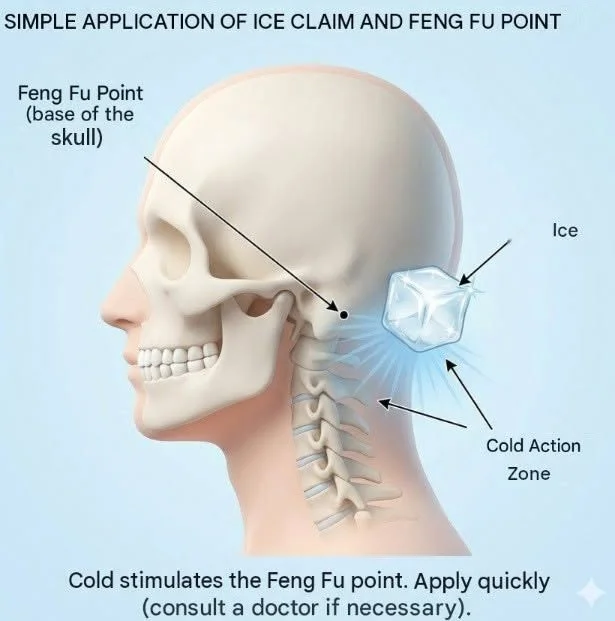
Before reaching for a pain reliever such as Doliprane, some people are discovering an unusual traditional wellness technique involving nothing more than an ice cube and a point at the base of the skull.
The technique is commonly known as the Feng Fu ice method. It involves placing a small ice cube against the area where the head meets the neck, allowing the cold sensation to stimulate the skin for a short period.
Images describing this practice often make impressive claims. Some suggest that applying ice to this particular point can relieve headaches, improve sleep, increase energy, reduce stress, and even influence the body’s internal balance.
But what is the Feng Fu point? Why do people apply ice there? And is there any scientific evidence that this simple technique provides the benefits frequently mentioned online?
Understanding the difference between traditional wellness practices and medically established treatments is important before trying any health-related technique.
1. What Is the Feng Fu Point?
Feng Fu is a point used in traditional Chinese acupuncture.
Its name is sometimes translated as “Wind Mansion.” It is identified as the GV16 or Du16 acupuncture point and is located at the back of the head, near the base of the skull.
More precisely, it is traditionally described as being in the depression just above the hairline, along the midline between the muscles at the back of the neck.
In traditional Chinese medicine, acupuncture points are associated with pathways through which vital energy, commonly called Qi, is believed to circulate.
The Feng Fu point has traditionally been associated with certain practices intended to address discomfort involving the head and neck.
However, these traditional explanations are not equivalent to established anatomical or physiological mechanisms. Modern medicine has not demonstrated that stimulating this particular point with ice produces the wide-ranging health benefits sometimes claimed online.

