
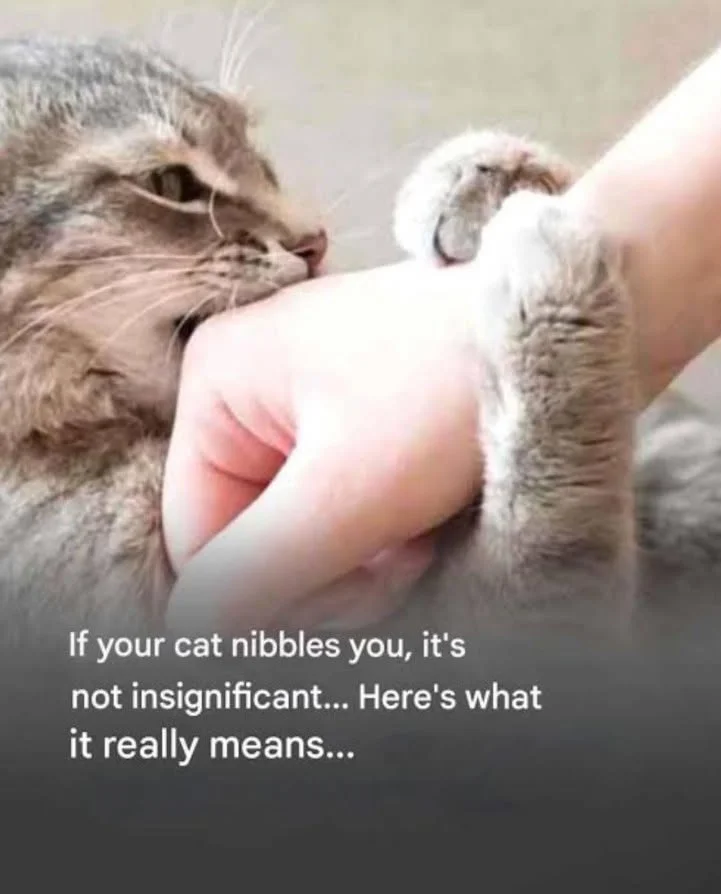
# If Your Cat Nibbles You, It's Not Insignificant... Here's What It Really Means
Cat nibbles can be confusing, sweet, or even mildly alarming when those sharp little teeth sink into your skin. If your cat nibbles you, it is not insignificant, and understanding this behavior is essential for decoding your feline companion's subtle emotional signals 🐾. Far from being random acts of aggression, these gentle or firm nips carry deep messages rooted in instinct, communication, and social bonding. When you grasp the psychology behind why our pets behave this way, you unlock a profound level of empathy and trust in your relationship.
Most cat owners experience this scenario regularly: you are petting your furry friend, everything feels calm and loving, and suddenly—chomp. You are left wondering what went wrong and whether you crossed an invisible boundary. To decode these moments, we must look at the physiological and psychological triggers that prompt a feline to use its teeth instead of its purrs. Recognizing these patterns helps you adjust your interactions and keeps both you and your cat safe and happy.
## The Evolutionary Roots of Feline Nibbling
Every cat nibble tells a story that stretches back thousands of years to their wild ancestors. In the wild, felines use grooming and gentle nipping as a vital tool for social bonding, boundary testing, and expressing excitement. When a domestic cat nibbles you, they are often channeling these ancient instincts right into your living room 🐈. Kittens learn boundaries through playful biting with their littermates, and sometimes adult cats carry this communication style over into their human relationships, viewing you as part of their extended clowder.
Understanding this evolutionary background removes the personal sting from the behavior and reframes it as a natural form of dialogue. However, distinguishing between affectionate love bites and overstimulation can sometimes feel tricky. Cats have sensitive nervous systems, and continuous petting can quickly trigger an overload of sensory input, causing a sudden shift from pleasure to overstimulation.
## Decoding Overstimulation and Boundary Setting
One of the most common reasons a cat nibbles you is sensory fatigue. While felines adore attention, their skin and fur are packed with nerve endings that can become hypersensitive after a few minutes of continuous stroking. A sudden nibble is often their polite, albeit sharp, way of saying that they have had enough touch for the moment. Paying close attention to tail swishes, flattened ears, or skin twitching can help you spot the warning signs before the teeth come out ⚠️.
Beyond sensory overload, cats use nibbling to establish personal boundaries and communicate their immediate emotional state. Sometimes they are simply feeling playful and want to initiate an interactive game, while other times they are craving attention or trying to redirect pent-up hunting energy. Figuring out the exact context requires you to observe their body language, the environment, and the timing of the interaction.
---
As you navigate these daily interactions, a deeper mystery often emerges about what is happening beneath the surface of your cat's mind during these moments, leading many owners to wonder if there is an underlying hormonal or neurological trigger that suddenly flips the switch from sweet affection to a sharp warning nip....👇👇

