
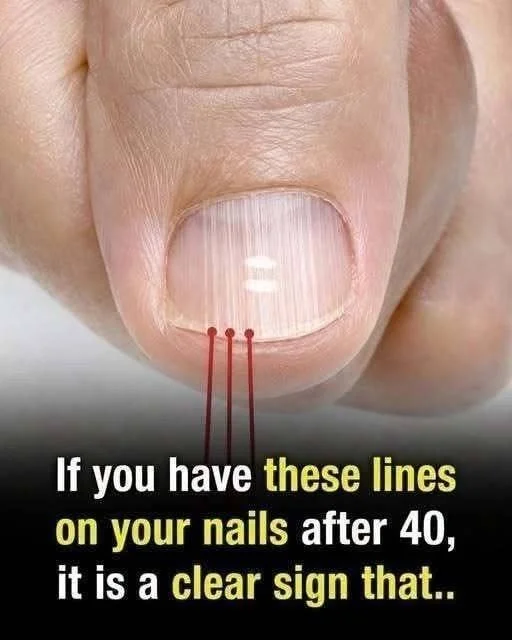
Have you ever looked closely at your fingernails and noticed thin vertical lines running from the base of your nails toward the tips? Perhaps they were barely visible when you were younger, but now they seem more noticeable. If you are over 40, you may have started wondering whether these lines are simply part of getting older or whether they could indicate an underlying health problem.
You are not alone. Changes in fingernail appearance are common as people age, and vertical nail ridges are among the most frequently noticed changes. While many people immediately associate them with vitamin deficiencies, poor circulation, or other medical conditions, the reality is more complicated.
In most cases, vertical ridges are harmless and represent a normal part of aging. However, certain nail changes can sometimes provide clues about nutritional deficiencies, skin conditions, infections, or other health concerns.
Understanding the difference between ordinary age-related nail changes and potentially concerning symptoms can help you decide when to seek medical advice.
What Are Vertical Lines on Fingernails?
Vertical nail ridges are narrow raised lines that extend from the cuticle, located at the base of the nail, toward its outer edge.
The medical term commonly used for this appearance is longitudinal ridging.
These ridges can affect one fingernail or several nails at the same time. Some are extremely subtle and only visible under bright lighting, while others create a noticeable uneven texture.
If you run your fingertip across the surface of your nail, you may feel small raised lines or grooves.
The appearance of these ridges varies from person to person. They may be fine and closely spaced or deeper and more pronounced.
As people get older, nail growth and the structure of the nail plate gradually change. This can make vertical ridges increasingly noticeable, particularly after middle age.
1. Normal Aging Is One of the Most Common Causes
One of the most common explanations for vertical nail ridges after 40 is simply the natural aging process.
Your fingernails are made primarily of keratin, a structural protein that also forms part of your hair and outer skin.
As you age, changes occur in the cells responsible for producing the nail plate. Nail growth may become slower, the surface may become less smooth, and the nails may develop a more noticeable ridged appearance.
You may also experience:
- Nails that become thinner or more brittle.
- Increased dryness around the cuticles.
- Nails that break more easily.
- Slower nail growth.
- Changes in nail texture.
- Less flexibility in the nail plate.
These changes do not automatically indicate that something is wrong with your health.
If the ridges have developed gradually, appear on several nails, and are not accompanied by pain, discoloration, or other unusual symptoms, they are often harmless.

