
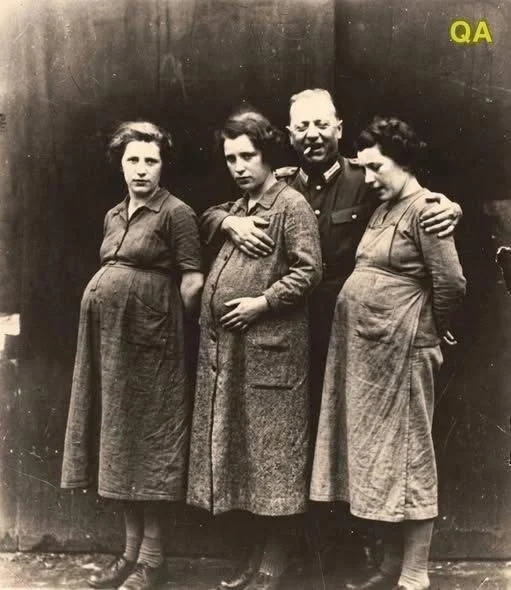
Although the specific story attached to the photograph remains unverified, the persecution and exploitation of women under Nazi rule are extensively documented.
Between 1933 and 1945, Nazi Germany established a vast system of prisons, concentration camps, forced-labor facilities, and killing centers.
Women were imprisoned for many reasons, including their Jewish identity, political activities, resistance efforts, ethnicity, and other reasons determined by Nazi persecution policies.
Their experiences varied depending on where they were imprisoned and how Nazi authorities classified them.
Many women experienced:
Forced labor under brutal conditions.
Severe food shortages.
Physical punishment and torture.
Sexual violence and exploitation.
Forced medical procedures.
Separation from children and family members.
Deportation and mass murder.
The United States Holocaust Memorial Museum documents the particular vulnerability of women to sexual violence in ghettos, concentration camps, and forced-labor settings.
Pregnant women faced additional dangers because Nazi authorities often treated pregnancy as incompatible with their demands for forced labor.
3. Sexual Violence and Abuse in Nazi Concentration Camps
One of the most difficult aspects of Holocaust history is the sexual violence experienced by female prisoners.
Women who were imprisoned in concentration camps had almost no control over their own lives.
They were deprived of freedom, privacy, basic necessities, and protection.
Some experienced rape and sexual assault. Others were subjected to sexual exploitation in exchange for food, clothing, or other necessities.
The United States Holocaust Memorial Museum also documents the establishment of brothels in certain concentration and labor camps, where women prisoners were forced to provide sexual services.
These institutions formed part of a wider system of exploitation within the Nazi camp network.
It is important to understand that prisoners could not freely consent to sexual relationships when their lives, safety, and basic survival depended on those controlling them.
The extreme imbalance of power made such exploitation especially brutal.
The experiences of women prisoners were not identical, and historians continue examining individual testimonies and documents to understand the full extent of these crimes.
4. What Happened When Women Became Pregnant in Concentration Camps?
Pregnancy could be extremely dangerous for women imprisoned in Nazi concentration camps.
At Auschwitz, pregnant women frequently faced immediate threats to their lives.
During certain periods, women whose pregnancies were discovered were classified as unable to work and were murdered or subjected to forced abortions.
Some women attempted to hide their pregnancies because they feared the consequences of being discovered.
Others gave birth secretly, often under terrible conditions, without adequate medical assistance.
The treatment of newborn children depended partly on the period, location, and policies operating within the camp.
At Auschwitz, Jewish newborns were murdered under camp policies for much of the period in which the women’s camp operated. There were changes in the treatment of some non-Jewish newborns during 1943, but survival remained extremely difficult.
The Auschwitz-Birkenau State Museum preserves historical records and testimonies documenting pregnancies, births, and the treatment of mothers and children.
These records reveal the extraordinary suffering experienced by women who were forced to give birth in an environment designed around imprisonment, exploitation, and mass murder.
5. The Nazi Obsession With Reproduction and Racial Ideology
The Nazi regime did not treat reproduction as a private matter.
Its racial ideology attempted to control who could have children, whose children were considered desirable, and which populations were targeted for destruction.
This ideology was central to Nazi eugenics policies.
The regime encouraged reproduction among people it considered racially acceptable while persecuting and attempting to prevent reproduction among groups it classified as undesirable.
These policies included forced sterilization, forced abortions, kidnapping of children, and other forms of reproductive violence.
Women imprisoned in concentration camps were also subjected to medical experiments involving their reproductive systems.
At Auschwitz, SS physician Carl Clauberg conducted forced sterilization experiments on hundreds of mostly Jewish women.
His procedures caused severe pain and sometimes led to infections, organ failure, and death.
Other Nazi doctors conducted sterilization experiments using different methods.
These crimes demonstrate how Nazi authorities used medical institutions and scientific language to justify violence against prisoners.
The victims were not informed about the procedures and were never asked for consent.
6. The Lebensborn Program: Another Part of Nazi Reproductive Policy
Another important aspect of Nazi reproductive ideology was the Lebensborn program.
Established under Heinrich Himmler’s leadership, Lebensborn was connected to the SS and Nazi racial policies.
The organization operated maternity homes and provided support to certain unmarried mothers and their children.
Its purpose was connected to the Nazi regime’s obsession with increasing the number of children it considered racially valuable.
During the Second World War, the program expanded into occupied territories.
German SS personnel, soldiers, and civilians fathered children with foreign women. In certain cases, Lebensborn became involved in caring for children whose ancestry was considered acceptable according to Nazi racial standards.
The program also became involved in the kidnapping of foreign children who were considered suitable for Germanization.
However, historians have distinguished the documented activities of Lebensborn from popular myths surrounding the organization.
It is inaccurate to describe every Lebensborn home as a place where SS officers systematically impregnated women.
The historical reality was more complicated and closely connected to Nazi racial ideology, population policies, and child abduction.
7. Could Three Sisters Really Have Become Victims of the Same Officer?
The possibility of sexual abuse by German personnel during the Nazi period cannot be dismissed.
Historical evidence establishes that women were sexually exploited by German men in occupied territories and in different forced-labor settings.
The United States Holocaust Memorial Museum documents cases in which Polish, Soviet, and Yugoslav women experienced sexual exploitation, sometimes resulting in pregnancy.
Some women were forced into sexual relationships in exchange for food or other basic necessities.
Others experienced rape and violence.
However, that general historical evidence does not prove the particular story presented in the photograph.
There is currently no reliable identification accompanying this image that establishes the three women were sisters or that a specific general fathered children with all of them.
A responsible historical account must distinguish between documented patterns of abuse and claims about individual people.
It is possible to recognize the suffering of women during the Nazi era without inventing details about unidentified individuals.
8. The Children Born During the Holocaust

