
Among the most heartbreaking chapters of Holocaust history are the stories of children born inside concentration camps or during forced transfers between camps.
For many mothers, pregnancy represented both hope and danger.
Some women concealed their pregnancies for months, fearing that discovery would result in death.
Others gave birth under conditions of extreme hunger, exhaustion, and inadequate medical care.
Yet some mothers and babies survived against extraordinary odds.
One documented example involves three Jewish women, Anka, Priska, and Rachel, who gave birth during the final months of the war.
Their children, Eva Clarke, Hana Berger-Moran, and Mark Olsky, survived the Holocaust.
The mothers had hidden their pregnancies while enduring deportation and forced labor.
Their children later discovered one another’s stories and reunited decades after the war.
These documented lives demonstrate that even in circumstances of extraordinary brutality, survival was sometimes possible.
They also remind us that every child born during the Holocaust had an individual story, and that those stories deserve to be preserved accurately.
9. Why Historical Photographs Must Be Examined Carefully
Today, millions of historical photographs circulate online.
Some are accompanied by accurate descriptions, while others have incomplete captions or misleading stories.
A photograph may be shared without its original date, location, photographer, or archival reference.
Over time, different versions of the same image may acquire completely different explanations.
Discover more
Herb
HERB
Ear
This can happen because people share emotional stories without checking their historical origins.
When examining a photograph from the Second World War, several questions are worth asking:
Who originally took the photograph?
The photographer may have worked for a military organization, newspaper, government agency, or private collection.
When was it taken?
A reliable date can help establish the historical circumstances surrounding the image.
Where was it taken?
The location may reveal whether the people were in occupied territory, a prison, a military facility, or another setting.
Is there an original archival description?
Museums and historical archives often preserve captions, documents, and other information associated with photographs.
Are the people identified?
Names and biographical records can help researchers establish what happened to the individuals shown.
Discover more
Study Chemistry
Shop Craft Beers
Study Anatomy
These questions are particularly important when an image is used to support an extraordinary claim.
10. Why the Stories of Women During World War II Deserve to Be Remembered
For many years, popular accounts of the Second World War focused primarily on military campaigns, political leaders, generals, and major battles.
However, the experiences of ordinary women and children were equally important to understanding the human consequences of the conflict.
Women served in resistance movements, helped protect families, worked in factories, experienced forced deportation, and endured imprisonment.
Some risked their lives to help others escape persecution.
Others survived concentration camps and spent decades rebuilding their lives after liberation.
Many never had the opportunity to tell their stories.
Historical research, survivor testimony, photographs, and preserved documents help restore these forgotten experiences to public memory.
Remembering these women is not simply about recalling suffering.
It is also about recognizing their humanity, courage, relationships, and individual identities.
Discover more
Find Treatments
Read Med Journals
Order Calendars
They should never be reduced to anonymous figures in a sensational online headline.
Final Thoughts: The Truth Behind the Photograph Matters
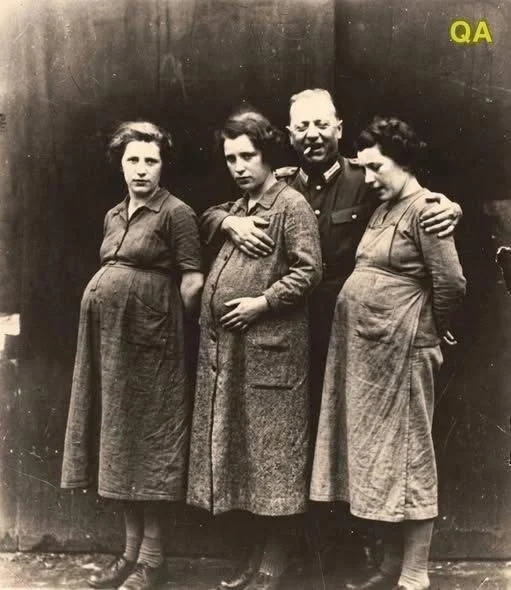
The photograph of three women standing beside a uniformed German officer raises difficult questions, especially when accompanied by the claim that a Nazi general impregnated three sisters who were prisoners.
However, the image alone does not establish that story, and the identities of the people shown cannot be confirmed from the photograph provided.
What is historically established is that women suffered widespread sexual exploitation, forced labor, reproductive violence, and other atrocities under Nazi rule.
Pregnant prisoners faced particularly brutal treatment, and many mothers and newborns did not survive.
These events are documented through survivor testimonies, camp records, and historical research.
The real history is already disturbing enough without adding unsupported details.
Every photograph from this period deserves careful examination, and every victim deserves to be remembered with accuracy and dignity.
Behind the millions of records documenting the Second World War were individual human lives, families, and stories that should never be forgotten.

