
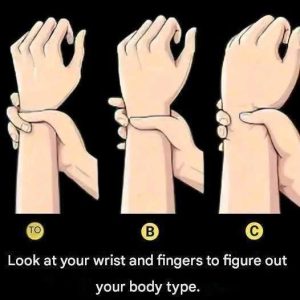
Did you know that your body type can impact the way you train, eat, and live? The following guide describes the traditional categories of ectomorph, mesomorph, and endomorph and their commonly associated characteristics. However, these categories are based on an older body-type classification system and are not considered a scientifically reliable way to determine metabolism, fitness potential, or the best diet and exercise plan for an individual.
Are You Curious About Your Body Type?
A Simple Body-Type Test
A commonly shared test can be performed at home:
Wrap your hand
around the wrist of your other hand, using your thumb and middle finger.
Notice how the fingers meet:
Ectomorph: The fingers are said to overlap or cross easily.
Mesomorph: The fingertips are said to touch without significant overlap or a noticeable gap.
Endomorph: The fingertips are said to remain apart and cannot easily touch.
This test should be viewed as a simple informal exercise rather than a scientifically validated method of determining body type or predicting how your body responds to food and exercise.
Characteristics Traditionally Associated With Each Body
Type
1. Ectomorph
Appearance: Traditionally described as lean, with relatively long limbs and lower levels of body fat.
Metabolism: Ectomorphs are often described as having a fast metabolism, although body size, activity level, genetics, diet, and other factors all influence energy expenditure.
Potential advantage: Some people with naturally lean builds may find it easier to maintain a lower body weight.
Common challenge: Gaining muscle mass can require consistent resistance training and sufficient calorie and protein intake.
Advice: Focus on progressive resistance training.
Eat enough calories and protein to support muscle
growth and recovery.
Allow adequate time for rest and recovery.
2. Mesomorph
Appearance: Traditionally described as having an athletic build, with relatively broad shoulders and a narrower waist.
Metabolism: Mesomorphs are often characterized as having a balanced metabolism and an easier time developing muscle, although individual responses to training and nutrition vary considerably.
Potential advantage: A naturally muscular or athletic build may make certain strength and fitness activities feel easier.
Common challenge: Maintaining a healthy balance of muscle and body fat still requires appropriate nutrition, activity, and recovery.
Advice: Combine
resistance training with cardiovascular exercise.
Maintain a balanced diet that provides adequate protein, carbohydrates, healthy fats, vitamins, and minerals.
Adjust food intake and activity according to your individual goals rather than relying solely on a body-type label.
3. Endomorph
Appearance: Traditionally described as having a softer or rounder physique and a greater tendency to store body fat.
Metabolism: Endomorphs are often described as having a slower metabolism, but body weight and metabolic rate are influenced by many factors and cannot be reliably determined from body shape alone.
Potential advantage: Some
people with larger or more muscular builds may develop substantial strength through resistance training.
Common challenge: Managing body weight and reducing body fat may require sustained attention to nutrition, physical activity, sleep, and overall lifestyle.
Advice: Prioritize regular resistance training and cardiovascular activity.
Choose a nutritious eating pattern that provides adequate protein and fiber while matching calorie intake to your individual goals.
A very low-carbohydrate diet is not automatically necessary. Carbohydrate needs vary according to personal preferences, health conditions, activity levels, and fitness goals.
What Your Body Type Really Tells
You
The ectomorph, mesomorph, and endomorph categories can be useful as a simple way to describe general body shapes, but they should not be treated as fixed biological types.
People naturally have a wide range of body shapes and compositions, and many individuals do not fit neatly into one category. Genetics, age, hormones, muscle mass, physical activity, nutrition, sleep, and other factors all influence body composition and how someone responds to exercise and diet.
Rather than choosing a diet or training program solely according to an ectomorph, mesomorph, or endomorph
label, it is generally more useful to consider your individual goals, current fitness level, health status, preferences, and response to training and nutrition.

