
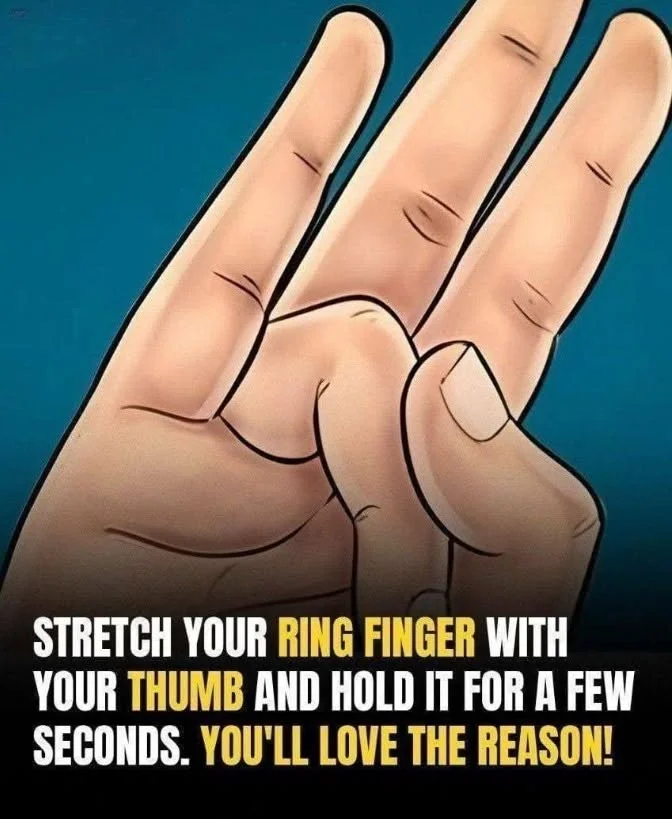
The ring finger has an interesting relationship with the nerves that supply the hand.
The median nerve generally provides sensation to the thumb, index finger, middle finger, and part of the ring finger.
The ulnar nerve supplies sensation to the little finger and the remaining side of the ring finger.
This means the ring finger receives sensory information from two different nerves.
The arrangement is one reason the ring finger can be particularly interesting when discussing hand anatomy.
For example, numbness affecting the little finger and the little-finger side of the ring finger may sometimes be associated with ulnar nerve compression.
However, stretching the ring finger does not automatically relieve nerve compression.
Persistent tingling, numbness, weakness, or loss of coordination should be assessed by a healthcare professional.
8. When Should You Avoid Finger Stretching?
Although gentle stretching is generally comfortable for many people, it is not appropriate to force a painful or injured finger.
Avoid the exercise or seek professional advice if you have:
- A recent finger fracture.
- A suspected dislocation.
- Significant swelling.
- Severe joint pain.
- A recent hand operation.
- A tendon injury.
- A finger that locks or catches painfully.
- Unexplained numbness or weakness.
People with arthritis may also need to adapt finger exercises to their individual condition.
The important rule is simple: stretching should feel gentle and controlled.
Stop immediately if you experience sharp pain, increased swelling, tingling, or unusual discomfort.
Do not pull a finger forcefully in an attempt to make it more flexible.
9. Other Simple Ways to Take Care of Your Hands
Your hands perform an enormous amount of work every day.
Taking care of them does not require complicated routines.
A few simple habits can make a meaningful difference.
Take Regular Breaks
If your work involves repetitive hand movements, take short breaks throughout the day.
Change positions and allow your hands to relax.
Avoid Excessive Gripping
Holding objects too tightly for extended periods can increase hand fatigue.
Try to use a comfortable grip whenever possible.
Maintain Comfortable Wrist Positions
When typing or using a computer mouse, avoid keeping your wrists bent for long periods.
A comfortable workstation can help reduce unnecessary strain.
Stay Physically Active
Regular physical activity supports general health and helps maintain overall mobility.
Pay Attention to Persistent Symptoms
Repeated pain, stiffness, swelling, or numbness should not simply be ignored.
Early assessment can help identify problems before they become more difficult to manage.
10. A Simple Daily Hand-Relaxation Routine
If you enjoy the ring finger stretch, you can include it in a short routine designed to relax your hands.
Try the following sequence:
- Relax both hands for a few seconds.
- Slowly open and close your fingers five times.
- Gently spread your fingers apart and release.
- Stretch your ring finger comfortably for five seconds.
- Repeat with the other hand.
- Move your thumb gently toward each fingertip.
- Finish by relaxing your wrists and shaking your hands lightly.
The entire routine takes only a few minutes.
You can perform it after typing, reading, cooking, or completing other activities that involve repetitive hand movements.
Remember that the goal is comfortable movement, not achieving the greatest possible stretch.
Final Thoughts: A Small Movement With a Practical Purpose
Stretching your ring finger with your thumb may look like an unusual trick, but it can be part of a simple hand-mobility routine.
The movement encourages gentle finger motion, gives your hands a break from repetitive activities, and may help reduce the feeling of temporary stiffness.
Its appeal also comes from its simplicity. You do not need special equipment, expensive products, or a complicated exercise program.
However, many dramatic claims about this technique go beyond what scientific evidence supports.
There is no established proof that stretching the ring finger can detoxify the body, regulate internal organs, cure diseases, or treat medical conditions through special finger-to-organ connections.
The real value is much simpler: taking a moment to move, relax, and care for the small structures that help you accomplish so many everyday tasks.
Sometimes, a few gentle movements are a useful reminder that even the smallest parts of our bodies deserve attention.

